What a school year it has been…I have seen joy and laughter; I have seen uncertainty and pain. Many people I know, especially teachers, have reached points of complete exhaustion along the way. I too have felt the weariness. These two-plus years of “the pandemic that won’t quite end” have taken a toll. I feel it when I sit next to a college student who is uncertain of his skills and afraid for his future. I feel it as I observe the elementary student with social anxiety who isn’t sure who her true friends are. I feel it when I see the young teacher who spent a year teaching online, and a year teaching 25 traumatized kids at 25 different levels, who is now questioning her calling. I feel it on those days when I wonder why I am so tired and yet don’t know how to process the deep emotions I feel; when the tears feel just under the surface and a few notes of a familiar song can spill them out. Sometimes they spill out in hope, after a glimpse of beauty; sometimes they spill out in sorrow, connecting with the pain of those I see or even strangers I read about that somehow don’t feel so distant because of our common humanity.
Treading Water
I am constantly moving Managing to stay afloat. I am determined to keep pressing on, Yet uncertain if I am getting anywhere. Will weariness defeat me?
I fear if I stop, I will start to sink; Resting feels out of reach. I am both inadequate and overconfident, Thinking I alone must keep my people safe. Will fear disable me?
I long for more than staying afloat, Desiring impact, meaning, love, change. I want to grow and help others grow, To swim toward a peace-filled shore. Will dependence strengthen me?
I will never give up. Yet it won’t be because of me, but as I depend on the Lord’s strength. He has loved me with a steadfast love. I always tell the girls that I mentor to “take the long-term view.” God will not leave us and he is not done loving us and transforming us for our good as we walk with Him. When I have trouble following my own advice, I need to once again fix my eyes on Jesus and trust in him! (Phil 1:6; Heb 12:2; Isaiah 26:3; Prov 3:5-6).
A final talk to seniors and students heading info finals…and I hope a blessing to you
I want to pray a blessing over you all, a blessing for your finals, a blessing for the summer, a blessing for your post-college life.
I’m sure for some of you, you’ve never had a blessing prayed over you.
I’m sure for just about every one of you, you have a vague sense of what I’m talking about, but you’re not really sure.
Blessing. What is a blessing? What is this idea?
Some of you when you go home may be asked to give a blessing at a meal. (This happens to me a lot, now that I’m a professional Christian)
Blessing to get engaged
Sometimes say ‘bless you’ when someone sneezes.
But what is its meaning?
Bible: Genesis 1:22 — God makes animals, then it says, Genesis 1:22 — And God blessed them, saying, “Be fruitful and multiply and fill the waters in the seas, and let birds multiply on the earth.” (ESV)
Genesis 1:28 — And God blessed them. And God said to them, “Be fruitful and multiply and fill the earth and subdue it, and have dominion over the fish of the sea and over the birds of the heavens and over every living thing that moves on the earth.” (ESV)
Genesis 2:3 — So God blessed the seventh day and made it holy, because on it God rested from all his work that he had done in creation. (ESV)
So we see that blessing has two ideas:
God’s favor: His positive inclination towards something or someone. It is the promise of a more powerful person to give, to protect, to bless, the lesser. It’s entering into a relationship with them for their good. All the life we see around us is because God has blessed the living creatures of the earth to have life. All the people of the earth are blessed to produce more life, as well as to be good stewards over the other things God has blessed. We are blessed with responsibilities. To bless is to give favor
Consecration: God blessed the seventh day, the day of rest. He set it aside as a day of rest to people, because we need that rest. When Israel were slaves in Egypt, they had no days off. I wonder, are we slaves to our work and school in America? God blessed the day off to worship God through rest, through praise and thanksgiving. To bless is to consecrate it.
These two blessings fall to all people. It’s called God’s common grace.
There is another blessing God gives called a covenant.
Covenant: God’s special relationship for favor and consecration, to set apart people for a more specific purpose. We see this in Genesis 12:1–3
Now the LORD said to Abram, “Go from your country and your kindred and your father’s house to the land that I will show you. And I will make of you a great nation, and I will bless you and make your name great, so that you will be a blessing. I will bless those who bless you, and him who dishonors you I will curse, and in you all the families of the earth shall be blessed.” (ESV)
God made a special partnership with Abraham, to bless Him, so that through Him, all the other families of the earth, the other tribes, cultures, people groups, could experience the blessing of God’s covenant with them.
Which brings up the opposite of a blessing…a curse.
To be blessed by God is the most wonderful thing you can possibly have, but that isn’t the default of the world God’s common grace is the default, but we are separated from God’s covenant because we’re all under the curse.
The curse is when death and destruction come, when things fall apart.
How did this happen, how does this happen?
When God put our first parents in the garden he put before them two trees. The tree of blessing, called the tree of life, and the tree of the knowledge of good and bad. They were to trust God to define right and wrong, trust God to live for Him, not for themselves, and thus eat from the tree of life, experiencing that covenant relationship of love.
But the deceiver came, and tricked them. God had told Adam and Eve that they day they eat of the tree of the knowledge of good and bad, that death would come…not that God would kill them, but that the curse would come, death would come, because they would no longer be under God’s blessing, but out on their own.
So the blessing of covenant is now the main story of the Bible. How will humans get back out of the curse and into the blessing of God?
The answer lies in God Himself. What humans could not do, get back to God, God did for us.
Jesus is God who became human. He lived a life that earned God’s blessing, yet when he was about 33 years old he received now the blessing, but the curse.
When Jesus died on the cross, he took the full weight of the curse upon himself. The apostle Paul says it like this in the book of Galatians
“Christ redeemed us from the curse of the law by becoming a curse for us—for it is written, “Cursed is everyone who is hanged on a tree”—so that in Christ Jesus the blessing of Abraham might come to the Gentiles, so that we might receive the promised Spirit through faith.” (ESV)
The blessing of Abraham, that every culture and people would be blessed through his offspring comes to us through Jesus, because he took the curse.
He was cursed so that we could be blessed.
We can experience the blessing of God, because God himself took the curse for us.
Now let me read the ancient blessing that God commanded the tribe of Israel, the descendants of Abraham to speak over one another.
Numbers 6:22–26
The LORD spoke to Moses, saying, “Speak to Aaron and his sons, saying, Thus you shall bless the people of Israel: you shall say to them,
The LORD bless you and keep you;
the LORD make his face to shine upon you and be gracious to you;
the LORD lift up his countenance upon you and give you peace. (ESV)
I was correcting one of my daughters in her thinking the other day, and I asked her some questions to try to get her to acknowledge the truth of what her choices were causing and resulting in…. She refused to respond and just stared with that little “eyes of steel” and straight-line mouth expression that she is so good at. I pressed further. After a few more moments of silence and my expectant penetrating gaze that she could see quite clearly out of the side of those hardened eyes, she verbally lashed out with exasperation, “Why should I answer your stupid questions when you already know the answers?!”
“Because, sweet girl”—my endearing name for my girls that helps me in those hot moments to remember that my correction needs to always remain grounded in love—”I am not asking for my benefit. I am asking because I am trying to teach you the good way, and I know that there is power in speaking what is true. I know that freedom comes from admitting things, and that we can only start to change our negative patterns when we see them clearly. It is harder to believe the lie that it is “me against the world” when I actually admit that I am wrong out loud (which is NOT to say others are not also wrong, but does make room for me to learn and grow). Then I can experience love and forgiveness and actually move towards making a better choice next time.”
I had to admit to my daughter that I also brought my sin into this encounter. I probably kept monologuing, like I often do—not particularly helpful… I was also defensive and snarky when I probed, “By the way, do your teachers ever ask you questions that they know the answers to? Hmmm?” All that to say, I need to learn and grow in this area too…
Verbally speaking things about ourselves—both celebratory and painful things—is meaningful. It matters to say it.
I like ___.
I am a Christian.
I am struggling with my identity.
I am feeling alone.
I don’t like that.
I did that thing that hurt you.
I was wrong (which is different from “I’m sorry”).
Why are these kinds of statements often hard to say?
The Bible points to this principle about how words can bring life and/or death in Proverbs 18:21, where it says “Death and life are in the power of the tongue, and those who love it will eat its fruits.”
Yet admitting my mistakes, and verbalizing my emotions and my fears enables me to take steps to move forward in a positive way. I want to embrace the truth, and I want to invite others into my journey of life and growth in this messy, broken world I find myself in. I don’t want my emotional energy to be used up in denying or hiding that thing I am ashamed of, or in worrying about what people will do when they see the real me. When I speak truth and receive grace from God (and hopefully from those around me who love me), then I can safely enter the process of healing and growing. It may be a long journey, but it is the road I need to travel.
We’ve been studying Romans 8 in church recently, in small group, we looked at v16-18.
Romans 8:16–18
The Spirit himself bears witness with our spirit that we are children of God, and if children, then heirs—heirs of God and fellow heirs with Christ, provided we suffer with him in order that we may also be glorified with him.
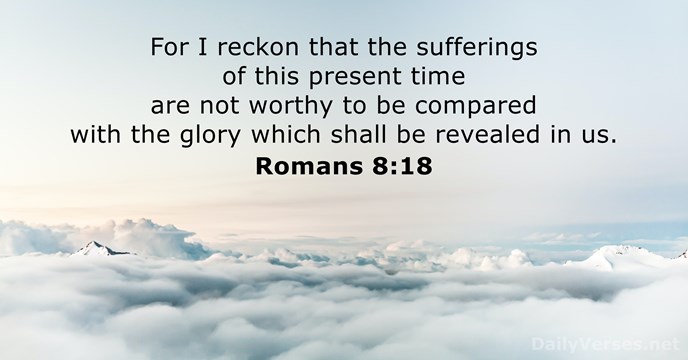
For I consider that the sufferings of this present time are not worth comparing with the glory that is to be revealed to us. (ESV)
So here are some of my thoughts on suffering. Suffering is inherently evil, bad. I say this because suffering will not exist in the age to come, in which we live glorified on a glorified earth. In that age there will be no sickness, no death, no dying. God will wipe away ever tear and we will be in perfect union with Him and with each other forever. I long for those days. But what about now? How are we to think about suffering, and specifically, how is suffering, which is bad, related to sacrifice, which is good?
So here’s what I wrote in my journal (excuse me if it’s unedited): “Should we seek suffering? No. But we should seek sacrifice. We should seek sacrifice, not suffering. We choose sacrifice, when we intentionally choose to say no to a good thing in this world. It could be for our spiritual growth, fo the sake of giving to other, for building God’s Kingdom. We choose sacrifice. But suffering comes to us. It’s an external thing that comes upon us. We don’t want it, didn’t choose it. Sacrifice is our fit to god. Is suffering God’s gift to us? No. And yet, God in His wisdom allows and even at times brings suffering to us, for our good, to call out to us, to chasten us, to discipline us, to mentor us, to form us into Christ-likeness.
And both sacrifice and suffering are the family business, they are what Jesus id while on earth. He suffered at the hands of sinful men when He offered his life as a sacrifice for our sins. He worshipped the Father in sacrifice even as suffering came upon him. Let me be like Him.”
Does it matter if we see life as temporary or eternal? Is this eschatological question even worth delving into, or does it just lead us on a nice little philosophical rabbit trail? I believe the answer is a resounding “yes, it matters.”
Colossians 3:1-4 [ESV] says:
If then you have been raised with Christ, seek the things that are above, where Christ is, seated at the right hand of God. Set your minds on things that are above, not on things that are on earth. For you have died, and your life is hidden with Christ in God. When Christ who is your life appears, then you also will appear with him in glory.
“If then…” What an incredible framing—these two little words carry grammatical and theological significance. This is about how our position in Christ changes how we look at life, how we interact with life, and how we live life. The Apostle Paul here points out that whether or not one is “raised with Christ” drastically changes one’s focus and identity. The phrase ‘If then’ implies that there is a contrast; if it is not true, then the statements that follow are inapplicable. The side of the “if” that people fall on can become the most important thing about them because it alters their goals and motivations.
Those who are in Christ have an eternal perspective. This means their focus changes from the temporal to the forever. They are to “set their minds” on things beyond this life. In fact, they already see themselves as dead to the things of this world.
What are the “things that are on earth” that grip human attention so strongly—that humans seek instead of “things that are above?” Living in a research university town, I have observed that the vast majority of students see success as bound up in getting good grades, going to a good grad school, getting a good job, and being able to live a comfortable life making good money. For some, it is even more—they feel the need to distinguish themselves as better than others by adding recognition through getting published, moving up the corporate/social/political ladder, and generally becoming known and respected. Those things are not inherently bad. But when people “set their minds” on those things to the exclusion of all else—making them ultimate goals—it fundamentally changes how they live and how they view other people. If the seventy to ninety years that we get in this life (if we are given that long) are all there is, then it makes sense to want to distinguish ourselves in these ways. But what if they are not all there is?
I believe humans are built with a “beyond themselves” orientation; this is evident even in those who reject God as having significance for their lives. It is common for people, including atheists, to speak of wanting to leave “something behind” or to have “a legacy.” They have a sense that it is not enough to just live for themselves in the here and now. I believe that is because they are made by God and in his image.
God, however, invites those of us whose identity is in Christ into the freedom of living not for ourselves, but for the hope of His glory. He invites us to be part of that forever glorious life and impact that Christ has. It is meaningful to see our impact as tied to eternal things. The implications of setting our minds “on things that are above” is not that we are then aloof and uncaring about the things on this earth, but rather that we care about what God cares about. We can act in ways that bring blessing to the earth, yet live free from the pressure of having to make our lives look ‘significant’ from a me-centered temporal perspective. God gives us a different calculus for determining significance—be part of what He is doing! The rest of Colossians 3 then teases this out as Paul moves into a profoundly relational description of life on earth.
If people are what is eternal, then it is indeed relationships that have the greatest impact. We get to use this time on earth to learn to love people, love learning, and to practice living with God’s values in mind. This life is an opportunity to touch and impact other eternal beings with love, hope and meaning.
So what can we do to orient our hearts to this eternal perspective? Lets remember a couple things. First, remember what is temporary. For example, John reminds us that the things of the world are passing away (I John 2:15-18). Paul reminds us that our bodies are mortal and breaking down, but God gives us hope for eternity with Him (2 Corinthians 4:16-5:8). Second, remember we are secure in Christ Jesus. In him I am a new creation (2 Corinthians 5:17), presented as blameless because of Christ’s finished work (Colossians 1:22), and with no need to prove myself because I am accepted by grace (Ephesians 2:8-9), able to do good out of love and joy, not to earn favor (Eph 2:10; Col 3:12-14).
The social and cultural waters we swim in can make it difficult to remember these things. We have to regularly remind ourselves of the truth of who we are in Christ. It helps me to periodically self-examine: “What is consuming my thinking time and emotional energy?” And “What is the ‘why’ behind my striving?” I can then ask God to help transform my mind and root my identity in him, so that I might “no longer live for [myself], but for him who for [my] sake died and was raised.” (2 Corinthians 5:14-15). I long to be free from fear and stress, so that I can do my work for His glory—not to justify my existence. My significance is not based on a worldly standard, but on the fullness of significance that Jesus has accomplished and has invited me to be part of. Therefore, as I face the ebbs and flows of frustration and discouragement when my nearsightedness gets the best of me, I can lift my eyes once again to things above, where Christ is and where true life is found.
This seems to be a key question in culture these days. It is behind the vitriol in debates about free speech, discussions about LGBTQ+ rights, conversations about school choice, CRT, religious freedom, gun rights, abortion, etc. Yet this question raises more questions, like: “How do we define harm?” and “How do we measure prevention of that harm?” and “What other interests and rights are we willing to sacrifice in the process?” The answers to those questions are often very perspective-bound, but stated as obvious absolutes, instantly marginalizing anyone who thinks differently (thereby polarizing news sources all the more because no one wants to read something that makes them feel marginalized). The answers are often then accompanied by a little self-justification like “well, I respect people who think differently, but….” (and then an under-the-breath thought ‘but those people are so stupid and uneducated.’ Or ‘but they are so corrupted and immoral’ or ‘if only they could see how unloving they are’).
As I think about it, I notice that the way the harm question is framed reflects the hyper-polarization and the moralizing language that is so popular right now. Everyone wants the moral high ground. By moving every debate into the moral realm, it allows us to feel superior, and to also frame disagreement, not as a different perspective, but rather as a corrupted and immoral outlook that must be squashed. It results in weapons of rhetoric being aimed at people rather than at ideas.
This is dangerous. It is destructive. It is like a gangrene that kills. This moralizing also in practice often turns us into hypocrites, as we try to use the very tactics that we recently lamented and called out as manipulative and power-driven when they were used by “the other side.” We then flatly justify our own behavior because it is in pursuit of “the good,” as defined by our perspective in our culture and in our time in history.
But is it possible that, in a pluralistic culture—as we look for a means for determining government engagement and structures—that we are asking the wrong question? Knowing that we live in a pluralistic world that we must somehow functionally and peacefully live in, we need to step away from the “everyone needs to think like me or the world will implode” mentality. I would say this applies equally to the hyper-conservative and the hyper progressive. I would also say it needs to be applied to temper the arrogance of even the moderately progressive and moderately conservative, who both roll their eyes at the extremes on both sides, but then also look down their noses at one another.
Instead of the “which harm is worse?” thinking, which means there has to be a winner and a loser, perhaps we need to instead ask “how can we treat humans with respect and engage in culture creation that values civility and human dignity?”
This does not mean we lose our beliefs or that we become wishy-washy. Do I believe in right and wrong? Yes. Do I believe that truth exists and can be pursued by humans? Yes. I actually personally believe that there is a sovereign God who created the world and humans and cares about us, knows what will lead to human flourishing, and graciously points us to it. I also believe I don’t have the authority or right to just change my beliefs to whatever I want to—I have placed the holy and gracious Creator God on the throne in my heart and life and that means I don’t get to play god. I believe making him Lord of my life is the best, most freeing decision I have ever made and that my relationship with him as my loving Father gives me peace, hope and purpose. I want more people to experience the hope and peace I have in Jesus. Yet I believe the best way to spread good news, particularly in a pluralistic community, is through love, service, and authentic dialogue. And I firmly believe I can desire good for people who think drastically differently than I do.
I think this principle is true for everyone, regardless of what their views of good news are. And I think, instead of squashing perspectives that don’t fit our notions of good, we should treat people how we want to be treated.
This then raises the age old kids’ objection: But then the other side will win because they aren’t going to play fair… My response to my children then is: “Well, lets respond instead of react: is the choice to get angry and bite back going to actually lead you to what you want, or will it just give you some momentary and fleeting feeling of ‘well, they deserve it,’ while loosing your credibility in the process?” Individuals must choose to respect and honor other persons as a valuable human beings, even when that respect is not returned.
The immediate question that follows, however, is then “what does it mean to respect?” Some would say if you don’t agree with me, you don’t respect me. If that is our mentality, then we are right back where we started—at an impasse. I respectfully disagree; I think respecting someone is seeing them as a human, with value, and treating them the way I want to be treated. The deeper question is, “Can I care about someone, and show kindness to them, even if they don’t like me or my views, even if they would like to demean me or silence me?” Jesus says I can, and he calls me to do it. He says “love your enemies, and do good, and lend, expecting nothing in return, …” (Luke 6:35). He then lived it out when he was here on earth. He lived with love and sacrifice in a culture and a time that did not embrace him. And guess what—it made a difference!
We have an obsession with individual choice in our culture. We want our individual rights. Now, it is not wrong to want to preserve rights—we in fact must commit ourselves to righting wrongs and seeking justice–, but I have noticed that a self-oriented focus on “rights” often comes at the cost of the broader community when people, simmering in frustration, cease to love and serve well. We can think, ‘if I do something for the good of the community, but other people don’t, then I will be at a disadvantage…’ We can talk ourselves into stagnation, wondering if choosing to sacrifice and serve is worth the cost to my comfort, my self-sufficiency, my power? Yet I would submit that there is real and personal long-term cost in not thinking about the broader community too!
Those of us who claim to be followers of Jesus should be the first to value the “we.” It is a critical part of Biblical teaching that we are to think of “one another” and are to count the needs of others above our own needs. We are called to care for the poor, to pursue justice, and even to love those we see as enemies. We are to display Christlike qualities of compassion, love, and grace—seeing people as made in the image of God. We are to do this, not out of our own strength (we cannot live up to this standard on our own!), but because God has poured out his love and undeserved favor on us. He accepts us as His children even as we were still (and are still) broken and messy and sinful. We love, because he first loved us. (I Jn. 4:19).
So…why don’t we see this others-centeredness—this servant-heartedness that should characterize those who claim Jesus—in a lot of “cultural Christianity” in the United States right now? It saddens me to see anger and self-justification instead. It undermines the trust of so many young people to see the church proclaiming Jesus, but then modeling bitterness, and vitriol and “what-about-me” thinking.
We cannot escape the tension in culture right now. There is a tension of ideologies because strong beliefs that are in many ways incompatible are vying for power in our political, social, and economic spheres. I am not saying we should ignore the tension, nor should we pretend it doesn’t matter what people believe. In fact, dominant ideologies deeply affect our communities and the coming future generations. They form the foundation for policies (social, economic, environmental), governmental structures (e.g., constitutional interpretation), education, and more. Yet, even if that is true, I don’t think we need to act like the world is ending if “our” (whichever ‘our’ you choose to align with—whether conservative, progressive, or something in between) perspective is not effectively winning in the power struggle over “X” issue. I believe we can have love and respect for people who think differently; I believe God is God, no matter what direction the culture goes; and I firmly believe that a posture of humility is what is most deeply needed in order to transform our culture.
Walking in humility means I seek to understand, listen, and care for people I don’t agree with. It means I believe both that I might be wrong in at least some of what I am thinking, and that I can learn a lot from those I disagree with. I can love people who are radically different from me without fear of losing my identity, because my identity is not in winning; it is in Jesus. Because I know that God will ultimately reign forever as the only truly good, loving, just and compassionate king, I don’t have to fear “losing.”
Our Cru group here in Davis has the tagline that we are “A caring multicultural community helping people follow Jesus.” We want to be known as people who care, and who believe that we have much to learn from one another. Yet our firm foundation is in Jesus and the Word of God because that is where we passionately believe that peace and life and hope are found—nowhere else.
It does not minimize the strength of my faith or convictions to listen to people who disagree with them. In fact, I can even advocate for the rights of people who disagree with me—for their right to have a voice! As an attorney who works in the area of Free Speech and Religious Freedom, I believe it is best to advocate for the rights of people of all faiths. I believe our diverse communities will be better if every religious community is able to teach and practice the tenets of their faith (of course within appropriate boundaries, such as preventing criminal activity and abuse).
Some will ask: am I in danger of “compromising” when I listen and seek to understand those with views I disagree with? No! I am in much more danger of losing myself and the message of grace and hope that is at the center of the truth claims of my faith when I allow bitterness or arrogance to poison me. “Learn and Grow” is a family phrase we use to represent the attitude and humility we want to have as we approach this journey of life. We absolutely want to do the work of grounding ourselves in truth (and God’s Word is where I want our family to be rooted), but we also know that learning and growing in our faith tradition is about much more than knowing things. It is about living in a Christlike way–walking in grace, truth, and humility.
Lets start with the admission, like at the beginning of an alcoholics anonymous meeting. Here it is: I am a struggling parent living in Achievementland (a.k.a. Davis). “Tell me more” you say. Well, I thought last year was hard…I thought it could only get better. But this year is hard too! I am not saying this year is all bad, nor was last year. I know I am blessed – I have a close-knit family. My kids feel loved, they love spending time together, and I love spending time with them. We got used to a lot of together time last year. It is the externals coming in and throwing a wrench in it right now. Activities are hard. We now have 5 kids with activities, and…it is a lot. But that isn’t really what I am struggling with…
School. It feels like it has changed. Covid ruined it! [Mini rant]. Hopefully not permanently [effort at optimism…].
OK, maybe Davis ruined it before that, at least at the high school level where there is so much crazy pressure…I am new to it and, wow…. Are any other parents wondering how we ever got straight A’s?
But I also feel like Covid has affected how school is done for elementary school aged kids. It feels like stratification in the class is more evident than ever. Some kids openly talk about how advanced they are, making the kids who aren’t feel worse. So much is still on computers: sitting in the class, yes, but doing many assignments on the computer… (i-Ready’s personalized programming sounds good, but I am concerned about a lot of math being done on a computer and I don’t want my child to feel like she is behind other kids because she doesn’t “get through it” as fast). My child, who I protected from it all by homeschooling last year (focusing on normal things like “math on paper worksheets” and “writing in a journal with a pencil”), goes through emotional ups and downs, often feeling behind because she isn’t as tech-savvy, and can’t navigate all the tabs and assignments as quickly as the other kids. While we did do some typing last year, she can’t type fast. I feel like I didn’t prepare her well enough, even though I helped her gain confidence in reading and math, and improved her ability to write (she even learned cursive!). My heart is weary, and I hate seeing my children experiencing stress! I love and respect teachers and know they are working hard (all my kids have some excellent teachers), and I know teachers are facing so many pressures and expectations that they neither chose nor designed… Yet I am concerned about school remaining screen-driven. It will change the pace, the feeling of calm, and will increase the comparison if we aren’t careful…
I am experiencing stress partly because I don’t feel like I have the bandwidth, with my job and many things I am juggling, to keep track of everything my children are doing in school. I am also struggling with the fact that I can’t fix it—I can’t homeschool right now because of my job responsibilities; I can’t make the stress go away! I can say I love my children and that I am for them—and I am saying that every day—but I am a little concerned about how to just “get used to this” feeling of school pressure and stress for the next 12+ years that I will still have at least one child in Davis schools.
Lord, I need you! I know you are bigger than all of this [turning to prayer, which for me is not just a desperation thing, but a daily life thing…].
I want to help my children know that their value is not in their “output,” but in the fact that they are precious children, created by and loved by a compassionate, personal, caring God. I want them to learn to work diligently and hard, but to rest in the unconditional love that their parents have for them—even though we live it out imperfectly—so that they can be confident that someone is always “for” them. Health (physical, spiritual, emotional) is more important than grades, and positive relationships and play time are critical for health. Yet it feels like swimming against the current to live with such priorities because they aren’t “resume builders.”
I must remind myself and my children that the LORD’s way is different, and good. Psalm 18:27-28 say “For you save a humble people, but the haughty eyes you bring down. For it is you who light my lamp; the LORD my God lightens my darkness.”

























 The Kepner Family